The Strip Is the Point: Britain’s Alt Clubs Are Trading Grids for Grain
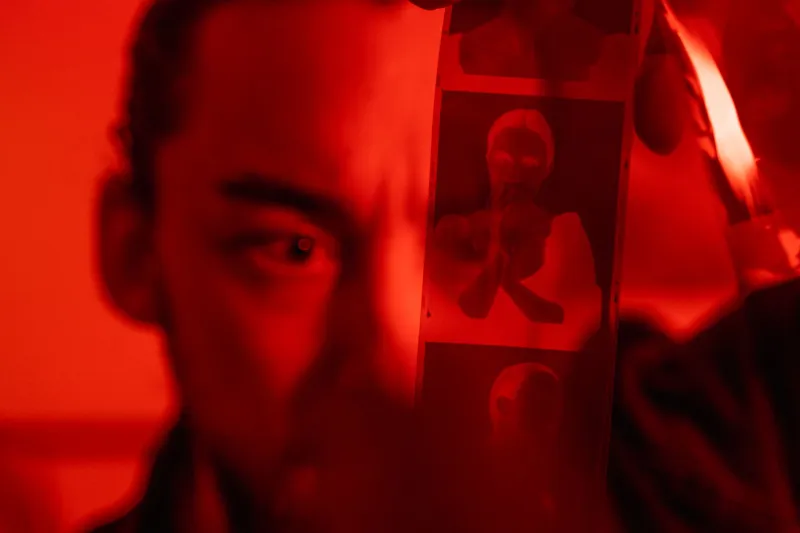
There is a particular sound that cuts through the bass at every good alt club in Britain right now. It is not a synth stab or a shouted drinks order. It is the whirr-and-clunk of a photo booth, followed by four people cramming themselves into a frame that will never make it to Instagram.
You know the one. Tucked beside the cloakroom, curtain half hanging off, a contactless reader glowing like a tiny shrine. Five pounds — sometimes four, if the venue is feeling generous — for a strip of four grainy, flash-bleached portraits. No retakes. No filters. No option to delete the one where your eyeliner has migrated to your cheekbone.
And yet, in 2026, that flimsy bit of paper has become the most valuable thing you will carry home. More than the wristband. More than the number you didn't get. More than the carefully composed mirror selfie that will sit in your drafts until the end of time.
Five Quid for Immortality
Let’s talk economics. A night out in alt Britain is not cheap — the ticket, the transport, the £7 pint you only half finish because someone dragged you to the smoking area. So why are we all suddenly queuing for a machine that offers nothing but four bad photos and a receipt?
Because it is the last affordable ritual left. The booth is a fiver for a shared experience, a physical object, and a tiny act of defiance against the idea that every moment must be optimised. You cannot edit it. You cannot add a vintage filter. You cannot post it to a story and watch the views tick up. You just get the strip, damp with someone else’s spilled drink, and you fold it into your pocket like a secret.
The venues have noticed. Booths are being repaired rather than left to die, and new ones are appearing in the corners of places that once saw them as clutter. In a railway arch in Leeds, the booth now has its own dedicated lighting rig. In a Manchester basement, the strip comes out with the venue’s logo stamped on the back — a souvenir of a night that officially happened. The £5 booth economy is small, weird, and thriving. It is nightlife’s answer to the vinyl revival: slower, less convenient, and infinitely more charming.
Posing Rules for the Undead
The etiquette is unwritten, but everyone seems to know it. Rule one: you do not hog the booth. Four frames, one minute, then out. Rule two: if a stranger asks to jump in, you say yes. The best strips are the ones where nobody knows each other’s names and everyone is leaning in at an angle that suggests they have been friends for years. Rule three: never look at the camera for all four frames. The first is for the pose, the second is for the laugh, the third is for the accidental eye contact with the person behind you, and the fourth is for whatever chaos happens when the flash surprises you.
There is something deeply vamp about this. The booth is a confessional box with a flashbulb. You step in as one version of yourself and emerge with evidence of another — messier, softer, more alive. The strip does not care about your grid aesthetic. It captures the smudged lipstick, the safety pin holding your top together, the way your friend’s platform boot is halfway up your shin. It is style as it actually happens, not as it is curated.
And it is queer, too. The booth is a space where bodies pile in without apology, where gender is played with in four frames, where the intimacy of the night is recorded without the pressure of performing for an audience beyond the curtain.
Grain as Gospel
Here is the thing about a phone camera: it lies. Not in a malicious way, but in a flattering one. It lets you take forty shots and choose the fifteenth. It smooths, brightens, crops. The booth does none of that. Its flash is unforgiving. Its grain is real. Its colours are slightly wrong in a way that feels more truthful than any filter.
That is why the strips are becoming an archive. People are pinning them to bedroom walls, tucking them into phone cases, sticking them to mirrors. In a few years, these scraps of paper will be the only record of what alt Britain actually looked like in 2026 — not the polished version, but the real one. The one with wonky fringes and cheap PVC and the friend who always blinks.
There is a political edge to this, too. We are constantly told to document everything, to build a personal brand, to optimise our online selves. The photo booth offers the opposite: a closed loop. The strip exists for the people in it. It does not need validation. It does not need a caption. It is a small, stubborn refusal to let the algorithm in.
The Last Analog Act of the Night
So next time you are in a club and you see that curtain twitch, do not walk past. Gather whoever is nearest — a friend, a stranger, the person who just complimented your boots — and pile in. Put your £5 in. Pull a face. Let the flash find you.
The strip will come out warm and imperfect. You will probably look terrible. You will definitely look like you were there. And that, in 2026, is worth more than any post could ever be.